Johann Flückinger’s vampire investigation
A History of the Vampire in Popular CultureJohann Flückinger’s vampire investigation was a pivotal encounter between epidemic fear, bodily evidence, and institutional authority. Sent in 1731 to examine supposed vampire attacks in a Serbian village, Flückinger and his fellow investigators confronted corpses that villagers regarded as active agents of death. Their report did not merely preserve a folk belief: its circulation helped make a local exhumation episode part of the expanding European history of vampirism and supplied later writers with an apparently documented case.
Causes and Historical Setting
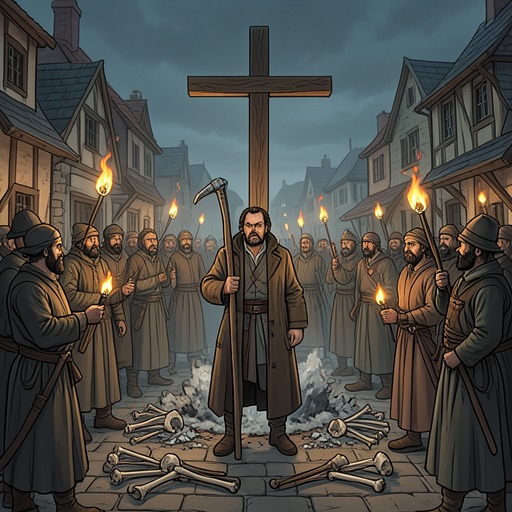
The investigation arose during the eighteenth-century vampire craze, when entire villages in eastern Europe became convinced that the dead were returning to attack the living. In the Serbian village concerned, thirteen deaths occurred in close succession. A doctor specialising in infectious diseases was sent to determine the cause and reportedly attributed the deaths to malnutrition, but the villagers rejected that explanation as insufficient and insisted that vampires were responsible. Their demand for exhumation shows how a community under pressure could treat a corpse not as evidence of death alone but as a possible continuing source of disease and mortality.
The episode belonged to a wider period of social uncertainty. The 1800s would later be described as a credulous and curious age, shaped by rapid technological change, spiritualism, and the persistence of older religious explanations, but the Serbian inquiry demonstrates that the same tension between emerging expertise and supernatural interpretation was already visible in the eighteenth century. Where medical knowledge could not provide an explanation that felt adequate to the scale or sequence of loss, vampirism offered a visible culprit and a ritual means of intervention.
The Examination of the Corpses
The first doctor was persuaded to exhume the suspected corpses. The bodies reportedly showed little decomposition, and their mouths appeared to contain what he believed to be fresh blood. These observations were treated by the villagers as physical confirmation that the dead had been feeding on the living. The absence of ordinary decay was especially powerful because it seemed to contradict the expected boundary between life and death: a buried body that remained apparently robust could be imagined as a body still acting in the world.
Officials in Vienna, unwilling simply to accept or dismiss the initial findings, sent the respected military surgeon Johann Flückinger together with other doctors and army officers as witnesses. Flückinger and his companions likewise found no major decomposition in many of the bodies and agreed that the corpses had taken on a plump appearance. The presence of military and medical observers gave the proceedings an official character, while the reported condition of the bodies preserved the central ambiguity: the investigators’ authority authenticated that something had been observed, even though the observations did not establish that vampires existed.
Modern accounts of such exhumations offer several possible explanations for the apparently vampiric signs. Blood around a corpse’s mouth or in its stomach may have been purge fluid, a red-black liquid produced as gastrointestinal tissues break down and pressure forces decomposing material through the mouth and nose. A stake could also release gases and fluids from a corpse, perhaps explaining stories that a body shrieked when pierced. The apparent plumpness of a corpse might likewise reflect post-mortem processes rather than renewed life. These explanations do not erase the historical event; they show how ordinary changes in dead bodies could become legible as supernatural evidence before modern medical knowledge was widely available.
Report, Circulation, and Authority
Flückinger’s report was mentioned in The London Journal in 1732, making it the first known reference to vampires in the English press. The movement from village testimony to official investigation and then to newspaper circulation changed the status of the story. It was no longer only a local account of suspected revenants. It became a portable report, capable of being quoted, repeated, and incorporated into wider arguments about spirits, corpses, and the limits of natural explanation.
The case also fed the learned literature of vampirism. Antoine Augustin Calmet, a Benedictine monk and renowned scholar from Lorraine, published his treatise on angels, demons, spirits, revenants, and vampires in 1746 and revised and expanded it in 1751. Known in translation as The Phantom World, the work drew on reports and correspondence about alleged vampires in Hungary, Bohemia, Moravia, and Silesia. The Flückinger investigation thus belongs to the same historical process by which village testimony, official paperwork, religious scholarship, and print culture mutually reinforced the impression that vampirism was a subject requiring serious inquiry.
Consequences and Cultural Afterlife
The investigation did not end vampire belief, nor did it settle the medical question behind the deaths. Instead, it created a durable record of disagreement. Villagers supplied a supernatural causal model; the first doctor proposed malnutrition; Flückinger and the officials documented striking physical conditions; later readers transformed the report into evidence for the existence, or at least the historical reality, of vampires. Fear was thereby given an archive. As the book’s broader discussion argues, folk tales can provide a target for anger and a sense of control when people face disaster without knowing who will die next or why.
The case also established a recurring pattern in vampire history: unexplained deaths produce suspicion, corpses are inspected for signs that contradict ordinary decay, experts are summoned, and the resulting account acquires authority through publication. Much later, newspapers would similarly amplify vampire scares, including the Glasgow campaign surrounding the Gorbals Vampire, where reports of children hunting a supposed monster helped fuel demands to ban horror comics. In both cases, media and institutions did not simply record fear; they helped organize and extend it.
Johann Flückinger’s vampire investigation therefore matters less as proof of an undead attack than as a demonstration of how evidence is made persuasive. A village’s grief, a corpse’s altered appearance, medical uncertainty, official inspection, and printed reportage converged into a narrative that survived because it occupied the unstable space between observation and interpretation. Its lasting significance lies in that unresolved boundary: the report documented what people saw, while subsequent cultures continued to argue about what those sights meant.